Evidence while your product is still a sketch.
At the conceptual design stage, when change is still cheap.
We bring the evidence forward so you can keep more options open and choose among them with data. Fewer late redesigns and fewer delays.
Keep your options open for longer.
Each line is a design option; each dashed line, new evidence. Options close when the evidence arrives, not before. In the end a few remain and a person chooses one (red circle).
IllustrativeThe cost of a late decision is the whole product.
Many design decisions are made with missing or partial information, scattered evidence and consequences that remain invisible. When those consequences appear, change is already expensive, slow and uncertain.
Decisions made late
Constraints appear when modifying the project has already become expensive.
Fragmented workflows
Tools are not always connected. Teams lose context, continuity and shared judgement.
Hidden impact
Performance, environmental impact and regulatory implications remain invisible until it is too late.
“If the aero doesn’t work, the car doesn’t work.”
Exterior Chief Designer · car manufacturer
“50–70% of projects are cancelled because the direction no longer meets business needs.”
Design Director · electric vehicle manufacturer
“That’s the biggest problem… sorting out the good stuff from the bad.”
Former Chief Creative Officer · car manufacturer
One decision platform. Evidence engines.
- Evidence engine · Physics & aerodynamics · TRL 5 · Open to pilots
AeroFlow
AI aerodynamic assessment from 2D views or sketches, before CAD. It compares concept proposals in seconds and shows which ones deserve a 3D model and CFD. It does not replace high-fidelity simulation: it directs it.
Today it works on the type of vehicle it has been trained on. We adapt it to your range with your simulations.
- Evidence engine · Geometry · TRL 7
Neural 3D reconstruction
Reconstructs the geometry of a product from images, views and scans, enabling reasoning about form, structure and physical behaviour without relying on complete CAD models.
- Decision platform · In development
Design Engines
Brings together alternatives, conflicting criteria and constraints, and establishes what evidence each choice needs.
The next evidence engines are open to industrial collaboration for joint research and development.
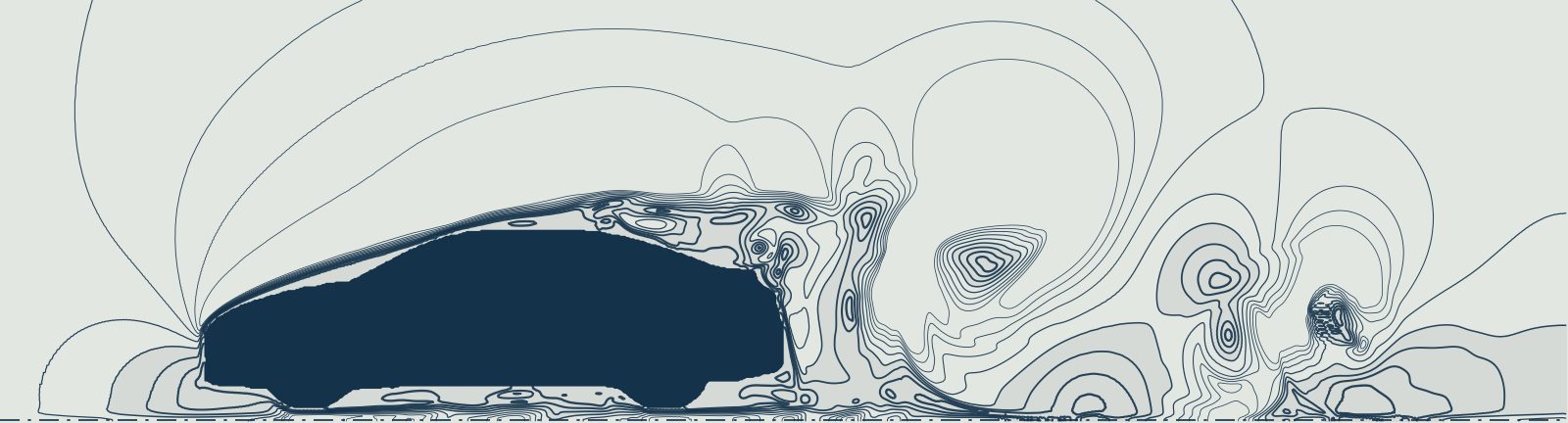
Aerodynamic feedback arrives while the form is still open.
- Concept views
- Develop the 3D model
- Set up and run CFD
- Feedback reaches the design → redesign
- Concept views
- AeroFlow prediction
- Concept review
- 3D development and CFD only for the selected concepts
A hundred sketches ten selected five 3D models.
Solid frame: with aerodynamic evidenceDashed frame: without evidence
100
all of them, with AeroFlow, in a fraction of the time
Every one of the hundred sketches gets an aerodynamic estimate before anyone decides which ones move forward.
5–8.5
days per concept
Aerodynamic evidence arrives after the 3D model. The other 95 concepts are discarded without it.
1–5
minutes per sketch
All 100 sketches, within a day of computing. 3D and simulation are kept for those that deserve it.
40%
less 3D modelling
If aerodynamic evidence rules out two of the five models.
Working time per concept, logarithmic scale. Today: 3D modelling plus simulation set-up. AeroFlow: view preparation plus prediction.
Assumptions behind this case
Process figures taken from automotive design studio practice; they vary by programme. AeroFlow: automatic preparation of three views from the sketch (20 to 90 seconds per view) and prediction in under 2 seconds per view. The estimate is for screening concepts; it does not replace high-fidelity simulation.
Built for those who have to decide.
For leadership
Gain early visibility into cost, risk, performance, time and impact before decisions become commitments that are difficult to reverse.
For design
Get technical feedback while the form is still being explored, without waiting for the 3D model or the simulation result.
For engineering
Explore alternatives faster, anticipate performance and bring aesthetic intent closer to technical feasibility.
Tested with design teams. Backed by research.
- Trials
Trial users
Automotive design teams in industry, academia and design services have tried AeroFlow. Names are kept confidential.
- Research
Peer-reviewed publications
Work presented at SIGGRAPH Asia 2025 and PhD Award at EACWE 2025.
- Ecosystem
Institutional backing
Spin-off of the Universidade da Coruña · CITIC · NVIDIA Inception.